Over the past year, we've gone from invisible in AI answers for our category to consistently showing up for the prompts buyers actually use. This is the playbook — updated with what nearly a year of running it has taught us.
It started with a brutal wakeup call.
Just weeks after launching Enterprise AIO and the AI Visibility Toolkit, I asked ChatGPT a simple question about AI monitoring tools. It named every competitor — but not us. Despite the launch, LLMs had no idea we existed in this space.
And that wasn't our only problem.
LLMs were citing our blog content hundreds of times. Yet traffic to our blog was falling. Citations showed reach, not positioning — an LLM could cite our content while recommending a competitor in the same answer.
We were losing measurable influence while our true competitive position stayed unclear.
That disconnect between citations and influence forced us to rethink everything.
So, we used our own tools to build a systematic approach to AI visibility. In one month, we nearly tripled our AI share of voice — the percentage of answers that mention us versus competitors — from 13% to 32% for our target prompts.

That was the summer of 2025. Since then, the discipline has moved fast. And so has our approach.
We've re-scoped what we measure, narrowed where we focus, and learned which tactics actually drive visibility (and which don't).
What follows is the framework we still use, what's changed since, where our visibility stands today, and how to run it yourself.
The measurement problem
The measurement problem is simple: Standard attribution can't see AI influence because LLMs shape decisions without sending a click or a conversion.
We could see LLMs using our content — citations confirmed that much. What we couldn't see was whether they recommended us, ignored us, or got us wrong. Usage isn't positioning, and positioning is what moves buying decisions.
The operational side was harder.
Rank tracking assumes stable positions you can check once a week. AI answers don't hold still: The platforms are non-deterministic, returning different responses to the same prompt within a single day. They also shift fast. In our study of 230K prompts across ChatGPT, AI Mode, and Perplexity, ChatGPT's citations of Reddit fell from nearly 60% of responses to around 10% in a matter of weeks.
So I decided we should change what we measured.
We stopped tracking whether LLMs used our content and started tracking our competitive position: whether we get mentioned at all, and how often versus competitors when we do. (Whether AI represents us accurately turned out to matter just as much — but competitive position came first.)
The two metrics that actually matter
The two metrics that actually matter are visibility and share of voice. Both work like familiar SEO metrics, except they measure influence instead of clicks.
| Metric | What it answers |
| Visibility | Are you mentioned at all for a target prompt? Binary — you're in the answer or you're not. |
| Share of voice | How often does AI mention you versus competitors across those answers? |
You can be visible in a single answer and still hold low share of voice if competitors show up in nearly all of them.
We track both across ChatGPT, Google AI Mode, and AI Overviews, among other platforms, using Enterprise AIO.

But the metrics only mean something measured on the right prompts.
Tracking "AI tools" tells you very little.
Tracking "best AI visibility tools for enterprise teams" tells you whether you show up exactly when someone is choosing a solution.
Get mentioned for prompts like that, and you've entered the buyer's consideration set at the moment that matters — without paying for an ad.
Our optimization framework
We still use the same five-step framework we built at the start. What's changed is the focus within it. Here's the process and how to replicate it.
Step 1: Identify your target prompts
Start by hand-picking the bottom-funnel prompts your team and stakeholders actually care about — the buying-intent queries where a purchase decision is in play.
We began with 39 prompts, like "best enterprise AI visibility platform," because they reflect real buying decisions. Today we track 726. But the bigger shift is the mix, not the volume.
We weighted the set toward buying-intent prompts, where AI is most likely to recommend a specific tool. We also kept a smaller set of informational prompts. Those rarely name any brand, so they won't move share of voice — but they show whether AI treats Semrush as an authority on the broader topic, not just a vendor to list.
The principle underneath all of it: The prompts you track are a tiny sample of everything people ask.
So we optimize for the intent they represent, the way you'd target a topic in SEO rather than a single keyword. Prompt research is how we pick the ones worth tracking.
To track your own set, use the custom prompt feature in Enterprise AIO. Starting without tools? Test variations manually across ChatGPT, Google AI Mode, and Perplexity.

Step 2: Establish baseline measurement
Set up tracking and measure where you stand before changing anything.
When we first measured, we sat at 13% share of voice for AI visibility prompts — confirming what we suspected. LLMs didn't know we had AI tools in this space.
That 13% reflected our original 39-prompt set. As the work matured, we re-scoped to the larger 726-prompt set, weighted toward harder, higher-intent queries. The two sets aren't directly comparable, so we reset the baseline to match the new scope: roughly 15% to start.
Enterprise AIO automates this, tracking your visibility and share of voice across AI platforms so you're not logging mentions by hand — which gets unmanageable fast.

Then track it daily.
Remember AI answers are non-deterministic. Daily data is what tells you whether a shift is real or just noise. Read every number as a range — a share of voice that swings between 20% and 40% over a day is normal, so "30% ± 10%" is the honest way to report it.
Step 3: Audit and upgrade your existing content
Audit the content you already own and find the pages where you can naturally strengthen your presence in AI answers.
The first move is natural product mentions.
Find content that already discusses the problems your tools solve. Work them in where they genuinely fit. We had a post on how to get LLMs to mention your brand. We updated it with a section on how Enterprise AIO's Source Impact Analysis reveals which sources LLMs actually cite — introducing the tool exactly where a reader would want it.
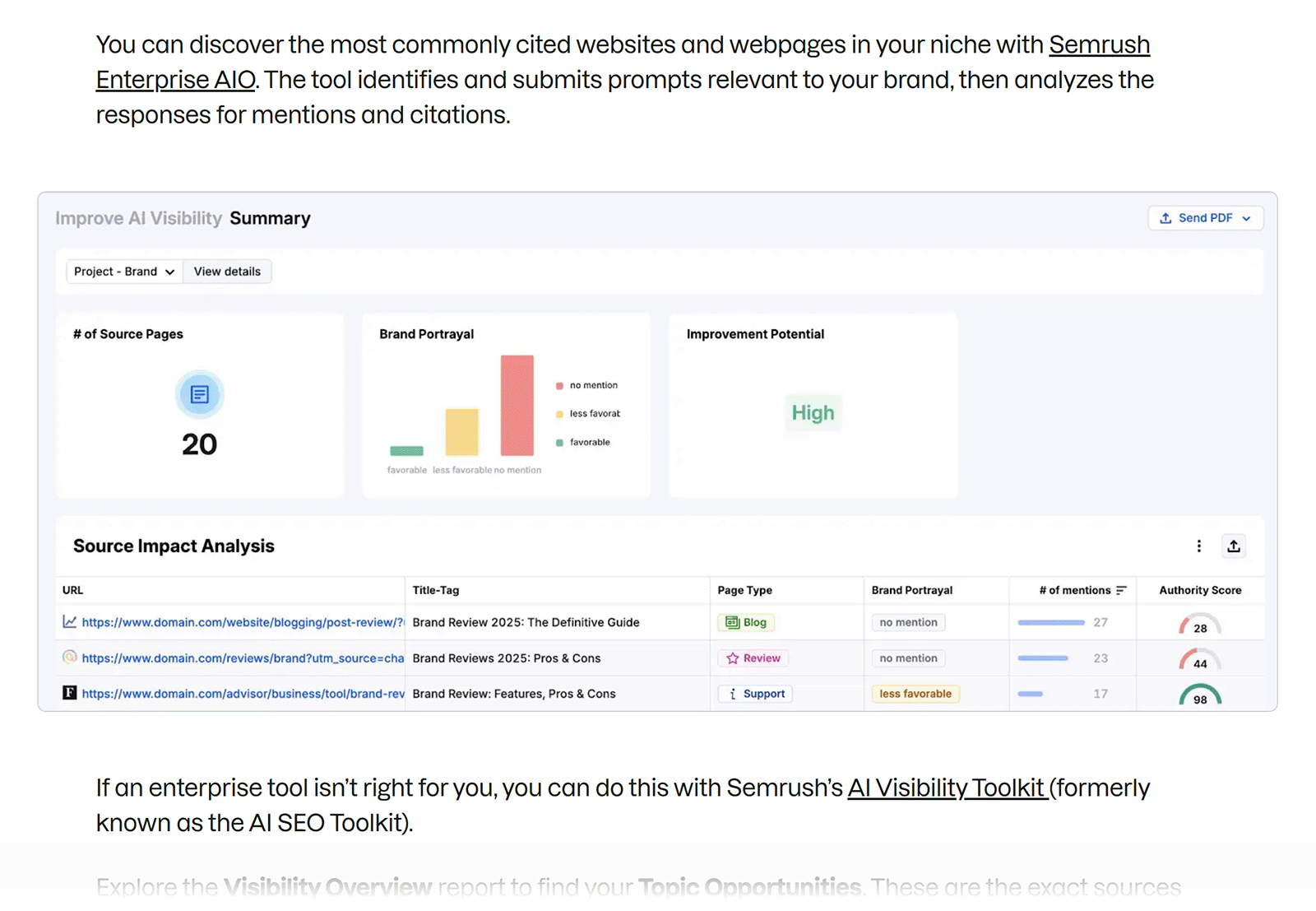
(No enterprise plan? The AI Visibility Toolkit does the same at a smaller scale.)
The second move is format.
We've been reworking dense articles into cleaner structures — direct answers up front, clear headings, comparison tables — which helps readers and the AI systems that pull from well-organized pages.
The third is the biggest shift in how we work.
When we find a content gap, we deepen our coverage of the whole topic behind it across our owned pages. That way, we show up however someone phrases the question.
The test is always the same: The mention should help the reader. If it doesn't, leave it out.
Step 4: Expand beyond your domain
Your own site isn't enough. LLMs pull from across the web — Reddit, Quora, LinkedIn, Medium, and industry publications.
At first, Reddit looked like the obvious place for us to start. But it's a separate project in its own right, one that needs real strategy, resources, and ownership. Its citation share also swings hard, as we saw in our most-cited domains study, so we've scaled back our focus there while we keep testing what works.
We're also testing LinkedIn and Medium, where we can publish directly. LinkedIn matters in particular — it's a rising citation source across AI platforms.
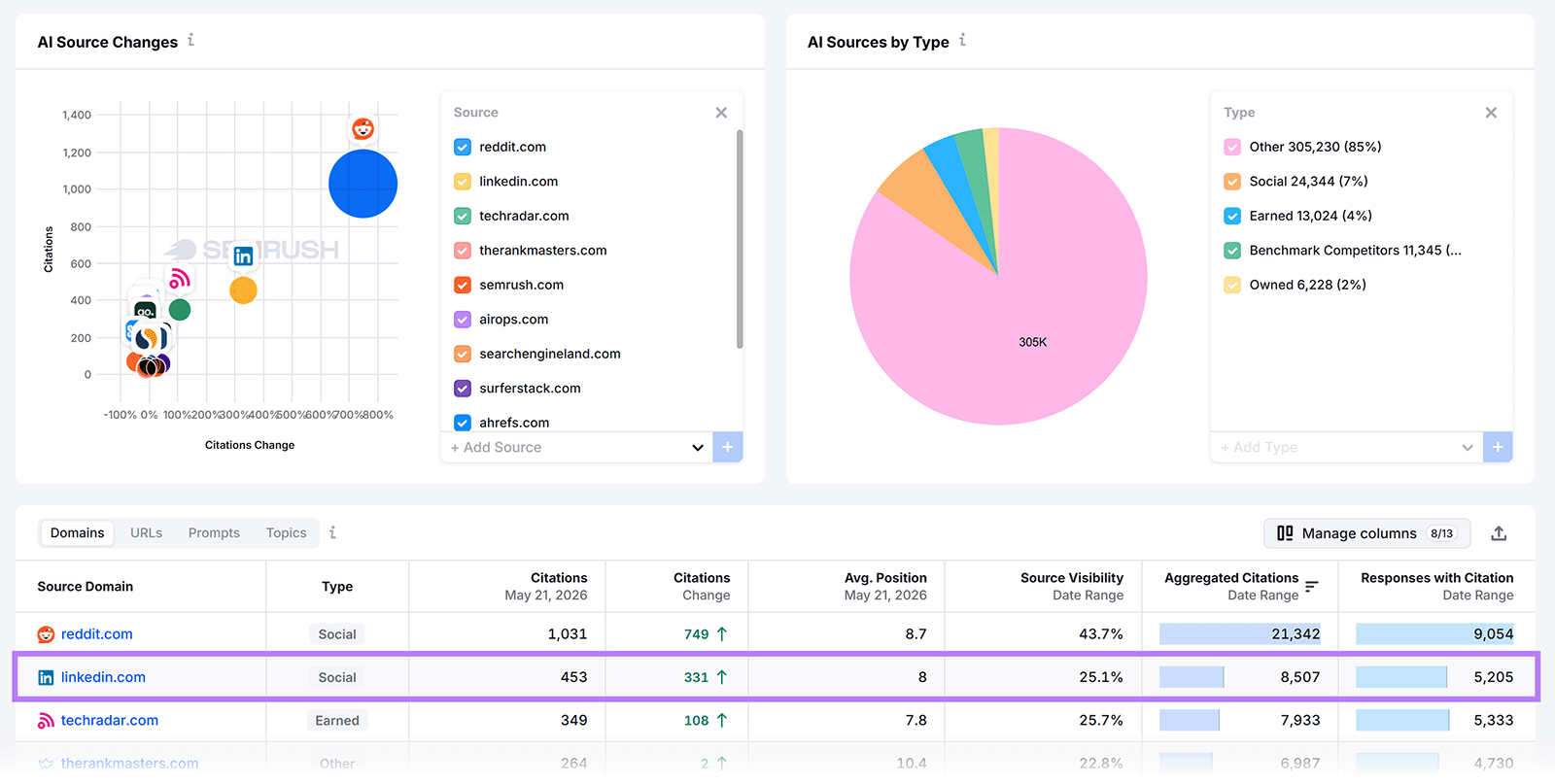
The piece that matters most is accuracy. Some of the pages LLMs cite most won't mention you, or will get you wrong — and AI systems reuse that same context across many answers, so one wrong claim can cascade.
That's why we've started scaling outreach in-house, building direct relationships with the owners of highly cited pages.
We're after one thing: accuracy. Fair criticism is one signal AI weighs against everything else; an inaccuracy gets repeated across answer after answer until it becomes the story. That's the real risk.
Step 5: Create fresh, citable content
Create new content that directly answers your target prompts, in formats AI can pull from easily, like listicles and comparisons. Make it authoritative and data-driven: real answers backed by specifics.
Here are the writing tactics our content team uses:
- Mirror the heading in your first sentence. If the heading asks "What is AI visibility?", open with "AI visibility is …"
- Answer the question completely in that first sentence, where readers and LLMs can find it fast.
- Back claims with specifics. "Cited in 3 of 10 responses for a target prompt" tells a reader far more than "our visibility improved."
- Skip analogies, idioms, and metaphors. Write "AI visibility is essential for discovery," not "AI visibility is the north star guiding ships through digital fog."
- Keep antecedents clear. "Enterprise AIO tracks brand mentions across AI platforms. The tool highlights new citations" reads cleanly; "It highlights new citations" leaves readers guessing.
- Choose clarity over flourish. AI has to understand and extract your point fast.
Results: What worked and what didn't
The approach worked, and it kept working as we raised the bar.
On the harder 726-prompt set, we've grown our share of voice from 15% to 25%. The gains reached beyond AI-specific topics, too: across roughly 1,000 SEO-related prompts, share of voice rose from 49% to 55% over six months — a sign that strong SEO and AI visibility move together.
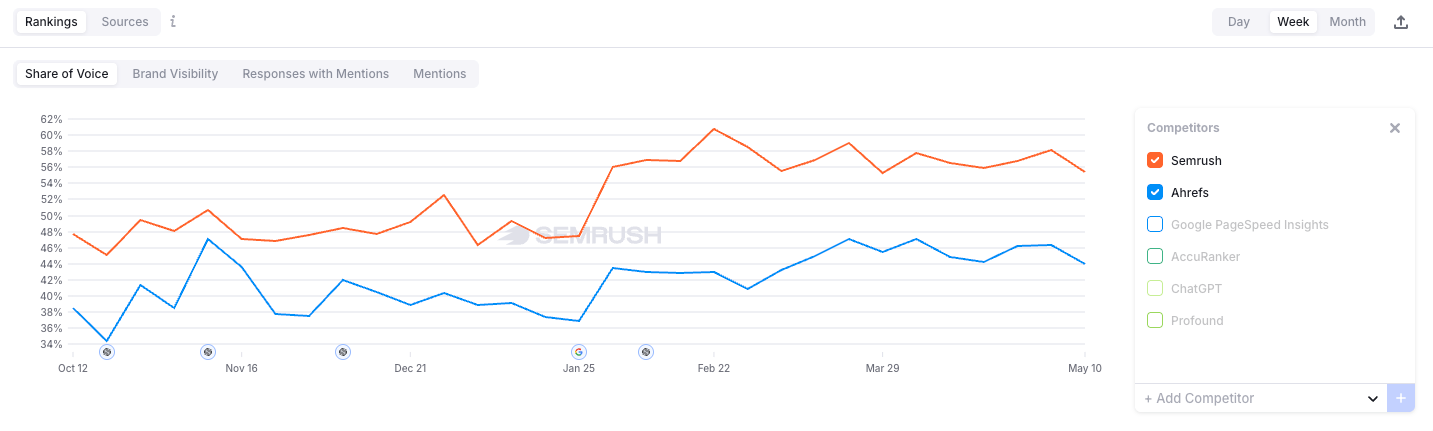
We can't fully isolate which tactic drove what, since we ran them at once, though expanding beyond our own domain consistently looked like a major lever.
Two things genuinely surprised us.
The first was speed — we saw movement in days, sometimes hours, far faster than SEO. But speed cuts both ways: Content decays just as fast, so a page losing visibility can't sit in a backlog.
The second is what still doesn't work — revenue attribution. Separating AI's impact from paid search, email, and everything else is genuinely hard.
The data is improving (Microsoft now reports AI performance in Bing Webmaster Tools, including how often Copilot cites your pages), but we're not there yet.
What this means for SEO teams
We're all figuring this out together, but some lessons are already clear.
A year ago, I tracked weekly ranking reports like everyone else. Now I check AI visibility daily, and I care as much about how AI describes us as about where we rank.
Here's what I'd tell another Head of SEO starting out:
- Expect your top-funnel content to lose traffic. People won't click when AI answers them directly, so measure visibility, not just clicks.
- Your own domain isn't enough, and accuracy matters as much as presence. Show up on the sites AI cites, and make sure they represent you correctly — a wrong claim spreads across answers.
- Prepare stakeholders for new metrics before you need budget. Your CEO still expects traffic, but your best results may not show up in Google Analytics.
- Build content processes for speed. When visibility drops, the fix can't wait in a backlog.
- Don't build your own AI visibility tracking. The API costs, upkeep, and data reliability issues make purpose-built tools the better investment.
This is an extension of SEO, not a separate discipline. The same fundamentals — authority, clear structure, relevant content — decide whether you show up, whether a person or a machine is doing the looking.
Google now says so outright. In its guidance on AI features, Google states that optimizing for generative AI search features is still SEO, and that foundational SEO is the basis for visibility in its AI experiences.
So the work isn't exotic. Track the new metrics, cover your topics the way good SEO always has, and stay close to the data as it shifts.
We're still learning. But this much is clear: teams that start now will be ahead when everyone else is scrambling to catch up. Better to start measuring than to wait for perfect clarity.